Why?
A single word. A complex question.

Glory be to the Father, and to the Son, and to the Holy Ghost.
As it was in the beginning, is now, and ever shall be.
World without end.
Amen.
Why?
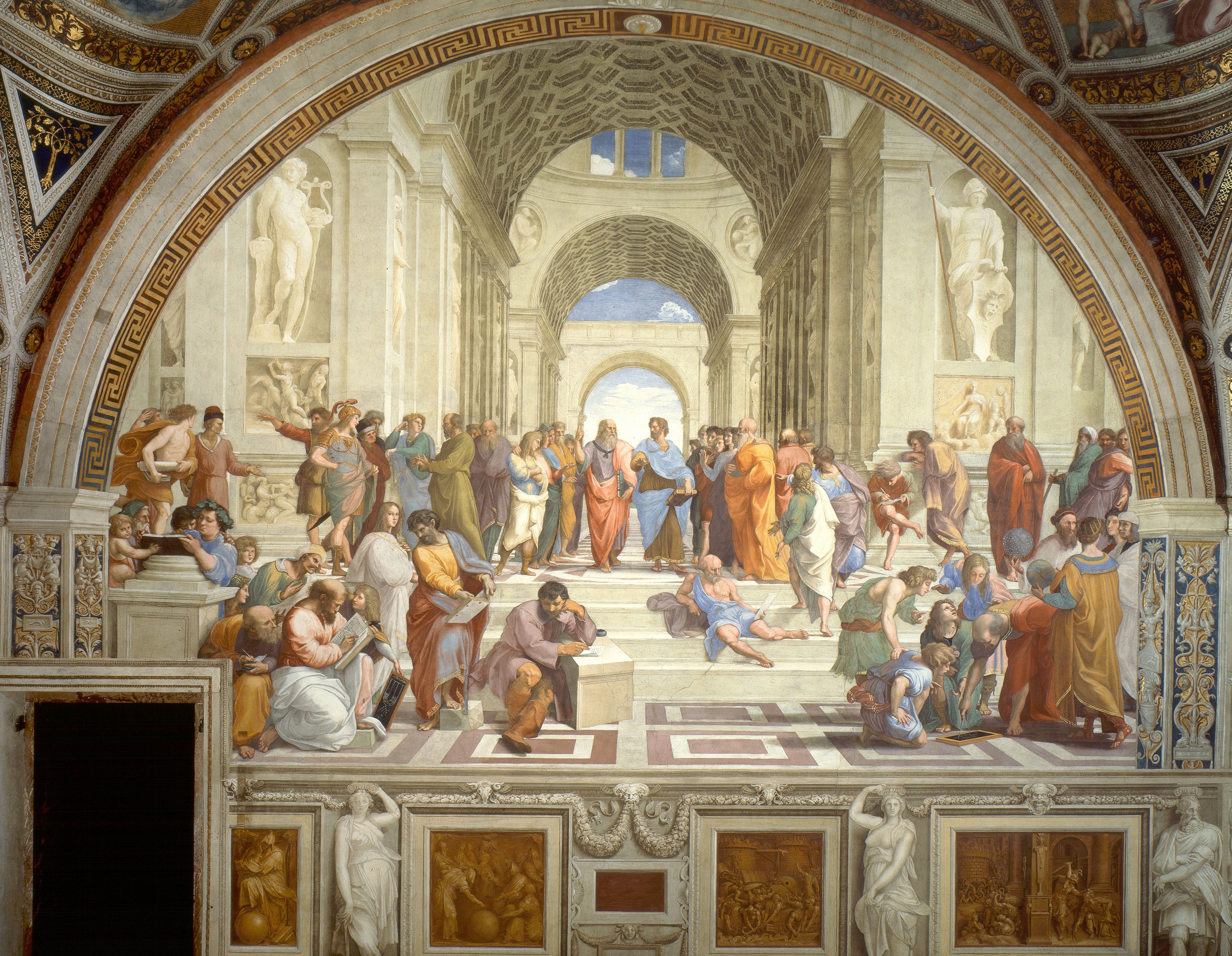
This is what we all want to know. Why are things the way they are? Why do I do the things I don't want to do and fail to do the things I do want to do (as St. Paul wrote and I myself witness)? To answer this, the Greek philosopher Aristotle proposed that we must understand four causes (perhaps Aristotle's Greek term is better translated as "explanation" than cause). Each of these causes answers the question of why, but none do so independently. Rather, all four questions must be answered if we are to truly understand why a thing is.
The Four Causes
Material Cause
The material cause is determined by what a thing is made from. A statue is materially stone, bronze, or some other material. Furniture is often made from wood. Dinnerware might be ceramic or glass. A house may be made from a combination of materials, including wood framing, a brick exterior, stone or porcelain tile, hardwood floors, metal fasteners, and so on. The material cause is probably the most obvious and easiest to understand.
Formal Cause
The formal cause describes the arrangement, shape, or appearance of something - what form it takes. Typically, this involves some sort of plan or design. A statue might be formed from a sketch or simply the mind of the sculptor. Furniture may designed using 3D modeling software. Houses are built from blueprints. This may also be used to describe certain features of things. A bust is made of bronze and depicts a historical person. A house has four walls and a roof. We can begin to create loose categories of things based on their form. For something to have a form, it must possess a degree or order, and thus it is ordered by something outside of it (the mind of the designer, architect, or creator).
Efficient Cause (or the Agent Cause)
Here, we move from the static object, or describing something as it is, to the dynamic - describing the changes that have occurred to bring it into being. This refers to the agent who fashioned the thing: the sculptor who shaped the clay, the builder who erected the house, and the musician who composed the song. There is a connection between the efficient and formal causes, but one should also pay attention to the subtle differences. The efficient cause refers not only to the agent acting but also to the process of shaping the thing over time.
Final Cause
The final cause is not concerned with what something is made of (the material cause), how it is organized (the formal cause), or how it came to be (the efficient cause). The final cause is an object's ultimate purpose, why it exists in the first place. This can most easily determined by asking the question, "What is its function?" A hammer may be used as a paperweight or to commit a crime, but neither of these is the final cause of the hammer; its final cause is to drive nails. A final cause does not necessitate other possible uses; however, there is a proper use of a hammer in driving nails that brings out its full potential.
What's so spiritual about a hammer?
Nothing really. But if we are to grasp unseen reality, or even a subtler aspect of seen reality (our behavior, why we do what we do), we must first understand and practice this perspective as it applies to concrete things. Next time, we'll take a further look at more concrete examples.
The grace of our Lord Jesus Christ,
and the love of God,
and the fellowship of the Holy Ghost,
be with us all evermore.
Amen.